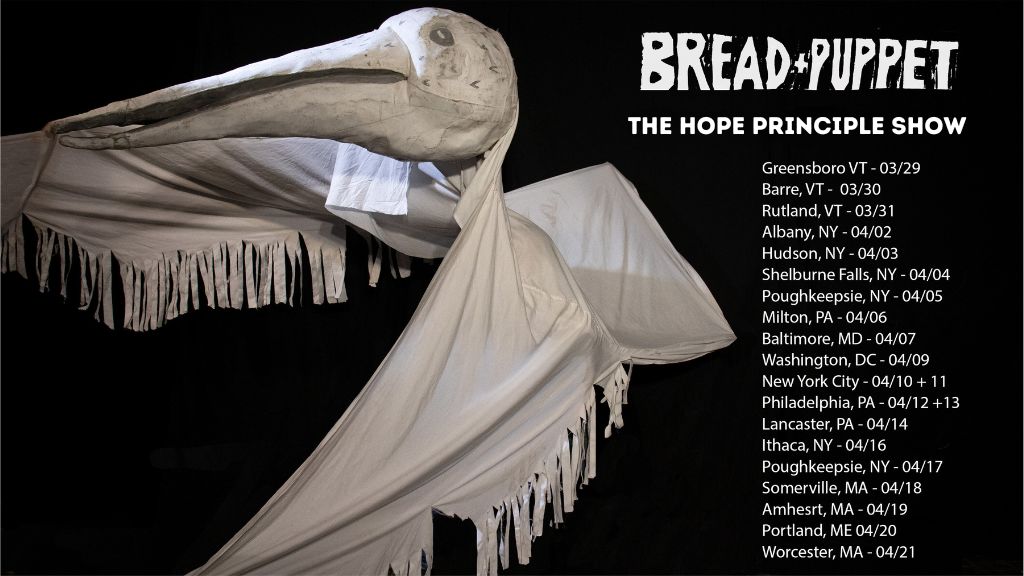
Tour Schedule
ABOUT OPEN DATES!!!
We don’t like them!
They’re no fun and they cost us money.
If you know of places where we can play, please write to: breadpup@together.net
or call Linda at 802-525-1271.
DIRECTIONS TO BREAD AND PUPPET THEATER
From the East:
Come up I 91 to Vermont exit 24, Sheffield/Wheelock. When you come off the exit ramp take a right onto Rte. 122 west (or north?). We are 13 miles up Rte. 122. If you get to Rte. 16, you have gone a mile too far on Rte. 122.
From the East:
Take I 89 east to Montpelier, VT. In Montpelier get on Rte. 2 east to East Montpelier, then Rte. 14 north to Hardwick. In Hardwick take Rte. 15 east. This will take you out the other side of town where in a few miles Rte. 16 north will come in on the left. Take Rte. 16 north @ 15 or so miles where Rt. 122 will come in on the right. There is a cemetery at this intersection. We are a mile up Rte 122. If you stay on Rte. 16 until you reach Glover Village, you have gone about a mile too far.
From Montreal:
Come down Rte. 10 east toward Sherbrooke. Near Magog get on Rte. 55 which
will bring you to the border crossing at Stanstead. You will then be on Interstate highway 91 south. Take that down to exit 25 in Barton, Vermont. When you come off of the exit ramp take a right turn onto Rte. 16 south. In a few miles you will come to Glover Village. Go through the village and continue south for about another mile. Rte. 122 will come in on the left. There is a cemetery at that intersection. We are located about a mile up Rte 122.
Once you are on Rte 122, you can’t miss us. There is a big barn (our puppet museum) and a farmhouse on one side of the road and an old school bus and a shed on the other.

[photo taken by Robert Henry Sturgill]
BACKGROUND OF THE BREAD AND PUPPET THEATER:
All Bread and Puppet Theater shows, created and designed by Peter Schumann with input from the company, use music, dance and slapstick to get their point across. Their distinctive imagery — featuring puppets (of all kinds and sizes), masks, costumes, paintings, buildings, and landscapes — seemingly breathe with Schumann’s distinctive visual style of dance, expressionism, dark humor and low-culture simplicity.
The Bread and Puppet Theater is one of the oldest, nonprofit, self-supporting theatrical companies in this country. Schumann founded Bread and Puppet in 1962 on New York City’s Lower East Side. The Theater is now an internationally recognized company that champions a visually rich, street-theater brand of performance art. Its shows are political and spectacular, with huge puppets made of papier-maché and cardboard, a brass band for accompaniment, and anti-elitist dances. Most shows are morality plays — about how people act toward each other — whose prototype is “Everyman.” Their overall theme is universal peace.
Besides rod-puppet and hand-puppet shows for children, the concerns of their first productions in New York were rents, rats, police and other problems of that neighborhood. More complex theater pieces, in which sculpture, music, dance and language were equal partners, followed. The puppets grew bigger and bigger. Annual presentations for Christmas, Easter, Thanksgiving and Memorial Day often included children and adults from the community as participants. Many performances were done in the street.
During the Vietnam War, Bread and Puppet staged block-long processions and pageants involving hundreds of people. In 1970 Bread & Puppet moved to Vermont as theater-in-residence at Goddard College, combining puppetry with gardening and bread baking in a serious way, learning to live in the countryside and letting itself be influenced by the experience. In 1974 the Theater moved to a farm in Glover in the Northeast Kingdom of Vermont. The 140-year-old hay barn was transformed into a museum for veteran puppets. “Our Domestic Resurrection Circus,” a two-day outdoor festival of puppetry shows, was presented annually through 1998.
Through invitations by Grace Paley, Bread and Puppet Theater became a frequent attraction at anti-Vietnam War events in the ’60s and ’70s. By the ’80s, the puppets had become emblematic of activist pacifism and a sine qua non of American political theater, as exemplified by the massive, ascending figures that are burned into the memory of anyone who marched with or saw the haunting, massive June 12, 1982 Disarmament Parade in New York City.
The company makes its income from touring new and old productions both on the American continent and abroad and from sales of Bread & Puppet Press’s posters and publications. Internationally, Bread and Puppet Theater performs massive spectacles with hundreds of participants, sometimes devoted to social, political and environmental issues and sometimes simply to the trials of everyday life. The traveling puppet shows range from tightly composed theater pieces presented by members of the company, to extensive outdoor pageants which require the participation of many volunteers. At most performances, the company distributes bread and aioli (garlic sauce) to the audience.
Peter Schumann was born in 1934 in Silesia. He is married to Elka Leigh Scott and they live in Vermont’s Northeast Kingdom. They have five children and four grandchildren. You cannot understand Bread and Puppet’s work without acknowledging that it is grounded in dance, but not in formal or classical dance. Schumann’s artistic pedigree is a mixture of dance and visual art.
He studied and practiced sculpture and dance in Germany and in 1959, with a childhood friend, musician Dieter Starosky, Schumann, created the Gruppe für Neuen Tanz (New Dance Group), which invented dances which sought to break out of the strict limits of both classical ballet and the expressionist dance tradition.
He moved to the USA with his wife, Elka, and their two children in 1961. His formative years in the Lower East Side during the early ’60s were heavily influenced by the radical innovations spearheaded by John Cage and Merce Cunningham. Schumann rejected the elitism of the ’60s arts scene and embraced the anti-establishment, egalitarian work of American artist Richard (Dicky) Tyler. He embraced Outsider Art: everyday movement, improvisation, direct momentary composition, and the jazz impulse toward overall creativity. He became a regular at Judson Poet’s Theater and Phyllis Yampolsky’s Hall of Issues, where puppet shows included making music and marching around. Street Theater productions followed, at rent strikes and voter registration rallies in the East Village, with crankies on garbage cans and speeches by a Puerto Rican neighborhood organizer, Bert Aponte.
He admired the abstraction of Merce Cunningham, and attended lectures at the Cunningham studio, but ultimately rebelled against it. In an interview with John Bell in 1994, he said that what “Cunningham demanded of his dancers was a classical ballet background. He refused to work with anybody who didn’t have that. I totally disagreed. I had traveled around in Europe teaching dance; to Sweden, to a dance academy and various places, pretending I was a great ass in dance, and gave them classes. And they took me — I was fresh and I just did it. I said, ‘I’ll show you what dance really is; what you do is just schlock,’ and I tried to liberate them from aesthetics connected to modern dance and classical ballet and to these various modes of existing dance at the time.’” There is dance at the bottom of all of Schumann’s work, but since puppet theater is traditionally a “melting pot” of all the different arts, the dance component is frequently obscured.